

Twenty Years In The Bear River
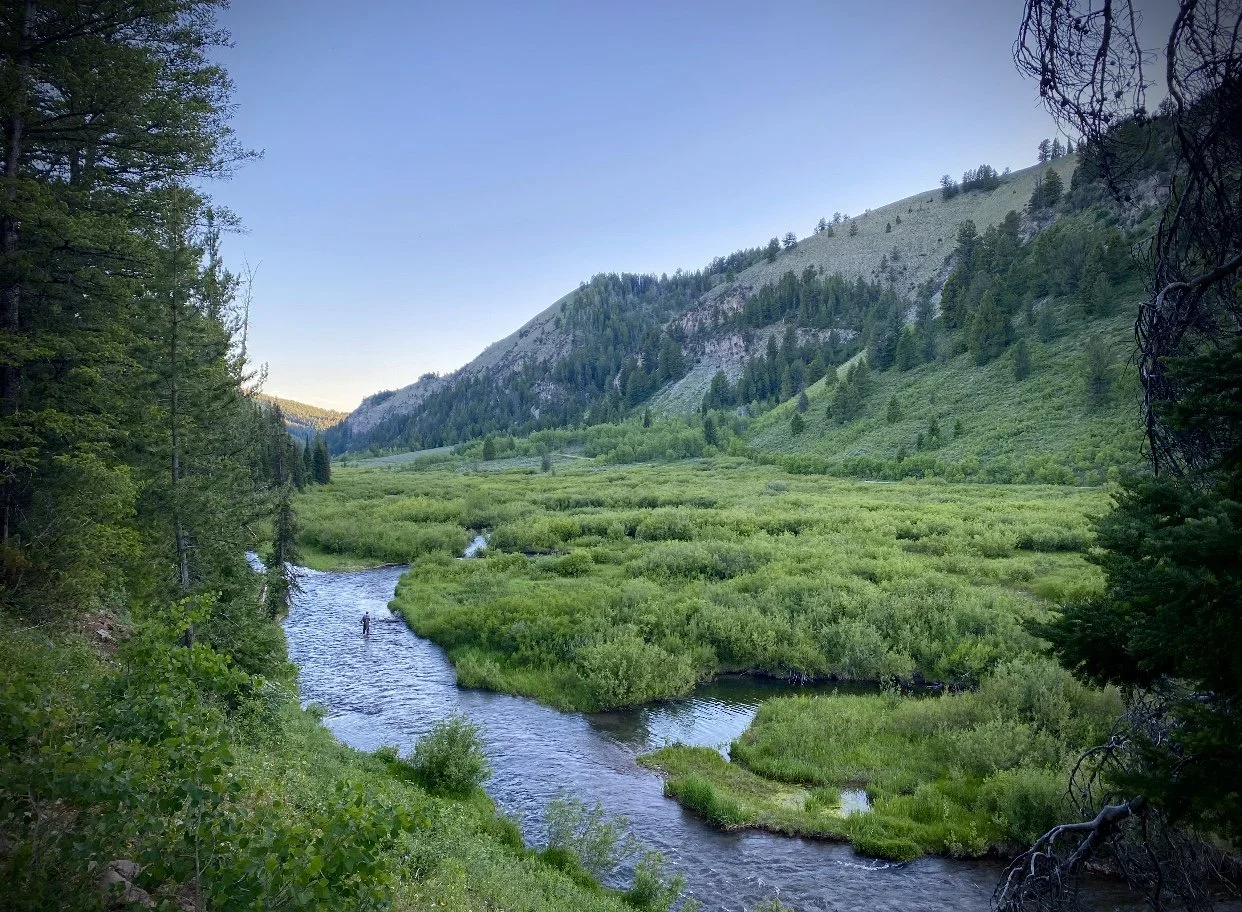
Photo By Tyler Coleman
On any given morning along the Bear River, it may be easy to forget how much time and effort it takes for a river like this to endure. Water moves steadily over rocks, and under willows, through pastures, and past communities that depend on it and the landscapes shaped by it. This river has also been shaped by the people, industries, and livelihoods that rely on its flow. To a casual observer, in some places it may look unchanged, even timeless; in others, you may wonder what the river has seen, and how long it will continue to persist.
The Bear River tells a different story to those who have stayed long enough to listen. Over the past twenty years, this river has been shaped not by a single project or moment, but by steady commitment, patient partnerships, and people willing to show up year after year. Every river needs a champion, and for over two decades, the Bear River has had people willing to take on that role.
Traveling more than 500 miles from its headwaters in the Uinta Mountains, the Bear River crosses state boundaries five times, flowing through Wyoming and Idaho before returning to Utah. It is the largest river in the western hemisphere that does not empty into the ocean, instead becoming the primary tributary to the Great Salt Lake. Along its course, the river passes through mountainous terrain, working agricultural lands, and urban communities. Nearly half of the land it flows through is privately owned, while the rest is managed by the U.S. Forest Service, the Bureau of Land Management, and State agencies, making restoration and long-term stewardship complex and deeply dependent on partnership.
It was within this complexity that the Bear River Program was born.
In the early 2000s, Warren Coyler recognized that the Bear River was more than a collection of individual reaches and isolated problems. He didn’t originally set out to build a career in fisheries. Looking back, he recalled, “About halfway through my undergraduate degree, I realized I didn’t actually want a profession in political science. I fell in love with the outdoors and rivers in particular and started thinking about how to angle myself toward a job in natural resources.”
He saw a river under pressure, fragmented by infrastructure and altered by decades of use, yet still persisting with potential. At a time when watershed-scale restoration was less common, Warren identified the need for a coordinated, long-term effort that could move beyond short-term fixes and instead focus on rebuilding function, connectivity, and trust across the landscape.
As he began stepping back and looking at the whole watershed as a system, something became clear. “This river’s in three states, and that’s kind of unusual, and it made me think this is a perfect place for Trout Unlimited to be working.”
Unlike other agencies that are bound by jurisdictional lines, Trout Unlimited could work at the scale of the watershed itself. As Warren explained, “We don’t have those jurisdictions per se. We can move kind of seamlessly across the state boundaries and do work in the high priority places.”
Warren helped establish the Bear River Program with a clear understanding that success would not come quickly, and that progress would depend on relationships as much as restoration techniques. His early work laid the foundation for a program built on collaboration, patience, and a willingness to stick around for the long haul. The intention to show up consistently, listen closely, and work collaboratively across state and management boundaries, continues to shape the Bear River Program today.
His early vision also had a very specific definition of success. Warren began to see that the river was effectively divided into segments by major dams, isolating fish from the tributaries they depended on. As he put it, “My first idea of success was to make sure that at least one primary spawning tributary in each of those reaches of the Bear River between the main stem dams was reconnected.”
As the Bear River Program grew, so did the scale and complexity of the work. The early vision of long-term, place-based stewardship carried forward under the leadership of Jim DeRito, the current Bear River Program Director, who has navigated the program through a period defined less by quick fixes and more by patience, coordination, and persistence.
Looking back, Warren described the lesson this way, “It taught me to stay the course and just continue to apply gentle, constant pressure forward to get things done.”
Jim’s work in the Bear River basin reflects an understanding that some of the most meaningful restoration opportunities are also the most complicated. These are places shaped by over a century of use, that have been altered by infrastructure that once served a purpose but no longer fits the river or the moment. Under his leadership, the program expanded in both scale and capacity, growing from a handful of targeted passage projects into a coordinated, watershed-wide effort supported by multiple staff, long-term agency partnerships, and increasingly complex restoration initiatives.
His dedication can be seen from the headwaters to the Great Salt Lake, but Paris Creek, Idaho is one such place that he sees as one of the biggest recent accomplishments. Since 1910, Paris Creek flowed under the constraints of a small hydropower diversion and power plant, its natural processes interrupted and its resilience diminished. While the impacts were subtle to the casual observer, altered flows and reduced connectivity over time left the system vulnerable, especially as drought tightened its grip across the West. Rather than attempting to manage around the problem, the decision was made to remove it entirely.
The Paris Creek Diversion and Power Plant decommissioning represents the kind of project that defines the Bear River Program today. It reflects a program confident enough to take on complicated regulatory processes, utility coordination, and long timelines in order to achieve lasting ecological change. It required collaboration across agencies, coordination with Trout Unlimited Partners, and a willingness from all stakeholders to engage in a long regulatory process, all in service of a simple but powerful goal, of letting the creek function as a creek again. By removing outdated infrastructure and restoring natural flow, the project reopened habitat, improved water temperature and seasonal connectivity, and returned a measure of resilience to the system.
Jim does not frame projects like Paris Creek in terms of blame for the past, but as opportunities to improve what exists. As he explained, “I don’t get hung up on who created the problem, I take it as a challenge to find a working solution.”
For Jim, Paris Creek stands out not because it was easy, but because it reflects what sustained conservation looks like in a working watershed. As an avid angler, he approaches restoration much the same way he approaches time on the water. “I believe in patience and persistence,” he said. “It does take time to achieve some of these projects, but ultimately the projects in and of themselves as well as collectively, make a difference for people and fish.”
It is a reminder that progress often comes from stepping back, listening to the river, and being willing to undo past alterations when the opportunity finally presents itself. Projects like Paris Creek signal a maturing program, one capable of taking on complex restoration efforts while remaining grounded in the same principles that shaped its beginnings.
While Paris Creek represents the program’s maturity, Bear Lake represents its proof of effectiveness.
When asked what he is most proud of from his years in the basin, Warren did not hesitate. “If I had to point to one thing, it would be the Bear Lake situation.”
There are six tributaries to Bear Lake, though only half provide meaningful spawning and early rearing habitat for migratory Cutthroat Trout of Bear Lake. Over the past two decades, fish passage and habitat improvements on St. Charles, Fish Haven, and Swan creeks have reshaped what was once a hopeful idea, into reality.
Warren remembers watching the percentage of wild cutthroat trout in Bear Lake increase from less than ten percent in the late 1990s to more than sixty percent in recent years. “It was just one of those moments where you’re so proud. You don’t see that happen very much in your own life where you can have that big of an impact.”
The lake, once believed incapable of sustaining a significant wild fishery, is now supported by tributaries that once stood disconnected.
